Cost Vs Value Of Home Renovations
Understanding cost versus value for Denver sellers
When Denver homeowners consider renovations before listing, the central question becomes: which projects actually increase sale price enough to justify the expense? The phrase cost vs value of home renovations captures that tradeoff. Riley Construction analyzes local sale prices, buyer expectations, and neighborhood norms to recommend improvements that are likely to deliver the best payback while avoiding unnecessary upgrades that rarely influence offers.
Instead of a one-size-fits-all checklist, Denver's market requires nuanced recommendations. What works in a Highlands bungalow is different from what sells in Stapleton or Cherry Creek. Buyers in different price bands look for different features; some prioritize turnkey finishes and lower maintenance, while others expect premium appliances and outdoor living. We balance projected resale impact against the realistic cost of construction and permitting here in Denver.
This guide outlines practical steps sellers can take to maximize resale value while controlling renovation spend. You will find project categories with typical cost ranges, expected payback patterns based on recent local comps, and a decision flow for prioritizing work. If you want a tailored assessment for your address and price range, contact Riley Construction for a complimentary review at 17206053614.
How Denver market dynamics shape renovation decisions
Local market dynamics-inventory levels, buyer demographics, and neighborhood trends-directly affect the cost vs value of home renovations. In a fast-moving seller's market, modest cosmetic updates can translate to multiple offers and higher sale prices; in a slower market, buyers scrutinize condition more deeply and expect certain updates to be complete. Riley Construction tracks sale-to-list ratios, days on market, and finished-comp features to advise which investments matter now.
Another important factor is the buyer pool. Denver continues to attract young professionals and families seeking proximity to transit, parks, and good schools, while also drawing some downsizers who value low-maintenance finishes. These groups place different emphasis on energy efficiency, storage, and modern kitchens. Understanding local buyer priorities helps determine whether a project will improve perceived value or simply add seller stress and expense.
Costs in Denver can also be higher than national averages for labor and permits, especially in densely built neighborhoods where access and staging are more complicated. Material supply fluctuations-like cabinetry lead times and lumber pricing-can change project timelines and out-of-pocket cost quickly. Our approach models those local cost realities and compares them to recent sale prices to estimate realistic payback ranges.
High-return renovations: where sellers typically see the best payback
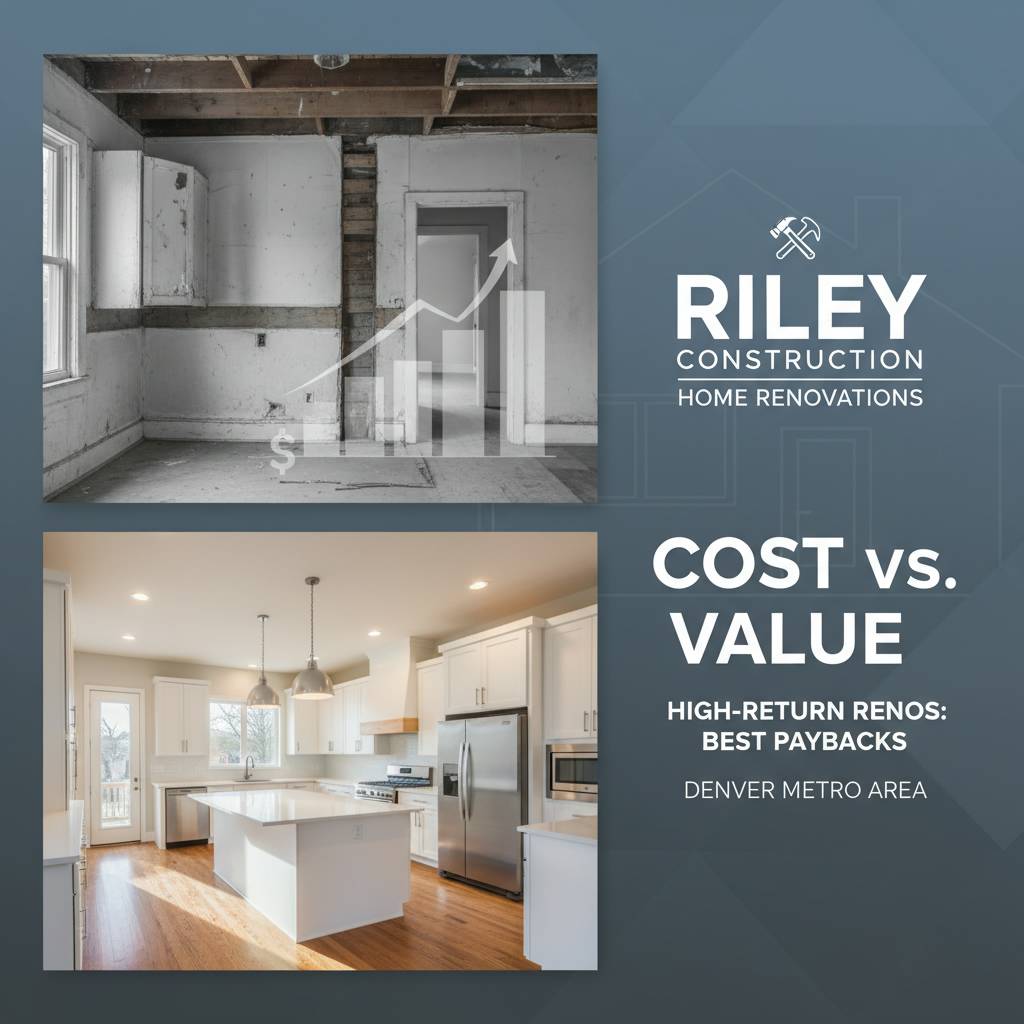 Certain projects consistently deliver a meaningful uplift in buyer appeal and resale price when done well. Midrange kitchen updates, refreshed bathrooms, and improved curb appeal are often near the top of the list for Denver sellers. These projects tend to solve buyer objections, modernize aesthetics, and require less disruptive scope than major structural work. We recommend focusing on improvements that make the home feel move-in ready to attract the broadest buyer pool.
Kitchen and bathroom updates
A thoughtful kitchen refresh-new cabinet faces or doors, updated countertops, modern hardware, refreshed backsplash, and energy-efficient appliances-can deliver a strong perceived value without a full remodel. Similarly, replacing dated vanities, regrouting tile, and upgrading fixtures in bathrooms can transform buyer impressions at a fraction of the cost of expansion projects. Typical cost ranges vary widely, so we model expected payback against comparable sales in your micro-neighborhood before advising.
Curb appeal and exterior maintenance
First impressions matter. Projects such as professional landscaping, painting the front door and trim, repairing walkways, and updating exterior lighting are relatively low-cost and often produce immediate improvements in showings and photography. For Denver buyers who value outdoor living and neighborhood walkability, well-maintained exteriors signal that the property has been cared for and can tip the balance in competitive offers.
Other cost-effective winners include replacing worn flooring in main living areas, deep-cleaning and staging key rooms, and ensuring mechanical systems (HVAC, water heater, roof) are in good working order. Buyers are more inclined to pay a premium for properties where big-ticket systems do not require immediate attention. and our team often prioritize these items for quick wins.
Renovations that often underperform for resale
Not all renovations produce strong returns. Luxuries that only appeal to a narrow buyer segment-such as extravagant custom built-ins, highly personalized finishes, or over-the-top landscaping-can fail to recoup cost and may even hinder sale by making the home feel too specific. Similarly, high-cost structural changes like adding major square footage or bespoke home-theater installations do not always result in proportional sale-price increases in many Denver neighborhoods.
Major kitchen expansions, basement luxury conversions, or high-end customizations can be excellent personal investments if you plan to stay, but they carry more risk when done solely for resale. Sellers should be cautious about heavy capital projects without clear evidence of similar investments in recent comps. Our analyses focus on local comparable sales to highlight projects that historically outperform in your neighborhood.
Another common mistake is investing heavily to chase trends-ultra-modern finishes, bold color palettes, or niche fixtures-that may be out of step with the larger buyer pool. Neutral, durable, and broadly appealing choices typically bring a higher probability of return. We help sellers identify which modernizations increase value and which are likely to be aesthetic risks.
How Riley Construction analyzes cost vs value of home renovations
Our evaluation begins with a neighborhood-level comparative market analysis (CMA) that looks at recent closed sales, pending listings, and active inventory with attention to finished features, age, lot size, and updates. We then overlay estimated renovation costs-sourced from Denver-area contractors, material quotes, and historical jobs-to model a likely payback range. This is not an exact science, but a data-informed projection that helps prioritize projects with the best risk-adjusted returns.
Key inputs in our model include typical project cost ranges, local sale-price premiums for comparable upgrades, time-on-market differentials for updated versus outdated properties, and buyer preference signals such as open-house traffic and offer patterns. When appropriate, we incorporate permit timelines and contractor availability into scheduling recommendations to avoid last-minute delays that can reduce net proceeds from a sale.
We present findings in a clear, prioritized plan: high-impact, low-cost items first; moderate projects next if budget allows; and major investments only when comps validate the expected premium. Our recommendations include rough cost ranges, likely payback percentages, and suggested finish levels to keep spending aligned with target price bands. If you would like a neighborhood-specific breakdown, reach out for a complimentary assessment at 17206053614.
Budgeting, timelines, and practical decision steps
 Renovation decisions for resale require a practical budget and realistic timeline. A short, targeted list of improvements completed within 2-6 weeks often makes more sense than a drawn-out renovation that pushes listing into a different market season. We encourage sellers to think in terms of return-on-investment windows: immediate (staging and cleaning), short-term (cosmetic updates and minor repairs), and long-term (major structural changes that might be better for a sustained ownership plan).
Use this simple decision flow to help prioritize:
- Identify buyer priorities from recent comps and open-house feedback.
- Eliminate high-cost projects with uncertain payback.
- Focus on maintenance, safety, and staging first.
- Implement targeted cosmetic updates that broaden appeal.
- Reassess before committing to major structural investments.
Pricing examples for planning purposes (local averages; actual costs will vary): kitchen refresh $10,000-$35,000; bathroom update $5,000-$20,000; exterior paint or trim work $3,000-$12,000; landscaping refresh $1,500-$8,000; flooring replacement $5,000-$20,000. We use local contractor estimates and recent job sheets to refine projections for your specific house and price tier.
Case studies and practical examples
Example 1: A 1920s bungalow in Berkeley that had a dated kitchen and original bathroom. A midrange kitchen refresh, bathroom updates, and targeted curb improvements cost roughly $35,000 total. After consulting with Riley Construction, the sellers listed at a competitive price and received multiple offers, ultimately selling for a price approximately 8-10% higher than similar unupdated comps. The improvement paid for itself when factoring reduced days on market and stronger offers.
Example 2: A South Denver home where owners invested $75,000 in a high-end kitchen expansion and custom finishes before listing. Comparable homes in the same block did not show a commensurate premium for that level of customization. The home sold, but net proceeds after renovation and extended market time meant the owners recovered less than the full cost of the remodel. This underscores the importance of aligning investment with neighborhood expectations and comps.
These examples highlight how the cost vs value of home renovations is context-driven. A project that yields great returns in one part of Denver can underperform in another. Our role is to translate neighborhood data and buyer signals into actionable renovation priorities that are more likely to increase net proceeds at sale.
Frequently asked questions
Q: How much should I spend on updates before listing?A: There is no fixed number. Start by addressing safety, major systems, and visible maintenance items. Then invest in high-impact, cost-effective cosmetic updates. We typically recommend allocating 1-3% of expected list price for light staging and repairs, and consider 3-8% for more significant refreshes depending on the property's condition and price tier.
Q: Should I get multiple contractor bids?A: Yes. Competitive bids provide a clearer sense of realistic costs and timelines. Also request references and recent job photos. Riley Construction can help interpret bids and suggest trusted local professionals. We weigh contractor quality and reliability alongside price to minimize surprises during the renovation-to-sale process.
Next steps and how to get a complimentary neighborhood assessment
Ready to make informed decisions about renovations that truly move the needle on resale value? Riley Construction offers a complimentary assessment tailored to your neighborhood and price range. We will evaluate local comps, estimate renovation costs, and recommend a prioritized plan that aims to maximize resale value while controlling spend. Contact us for a no-obligation consultation at 17206053614.
For sellers who prefer a quick checklist, we provide an easy-to-follow pre-listing guide that highlights immediate repairs, staging tips, and the top three high-ROI projects for your area. If you have questions about a specific upgrade or want to review contractors, reach out and we'll walk you through the options in plain terms.
Closing
Understanding the cost vs value of home renovations helps Denver sellers avoid costly upgrades that don't pay off and focus on improvements that actually attract buyers and raise offers. Riley Construction analyzes local sale prices and buyer expectations to recommend projects with the best payback. For a complimentary, neighborhood-specific assessment, contact Riley Construction at 17206053614 and let us help you maximize resale value while controlling renovation spend.